What Is a Reciprocal Link in SEO? Is Link Exchange Safe or Risky?

Written by Shivam Panchal
Founder & SEO Consultant, SEO Shades
Are you building backlinks to improve your website’s Google rankings? Have you ever approached another website owner and said, “You link to my website, and I’ll link to yours”?
If you have, you’re already familiar with the concept of reciprocal linking.
But here’s the important question: Does exchanging backlinks actually help your website rank higher on Google, or can it put your website at risk of being treated as spam?
Reciprocal linking is a common topic in link building, and there’s a lot of confusion about whether it is a good or bad SEO practice. The real truth is that not every reciprocal link is harmful. What matters is why the links exist, how they fit into the content, and whether they genuinely help users.
In this article, I’ll explain what reciprocal links are, walk you through practical examples, discuss Google’s approach to link exchanges, and share how to handle reciprocal linking without turning it into a risky link-building strategy.
What Is a Reciprocal Link in SEO?
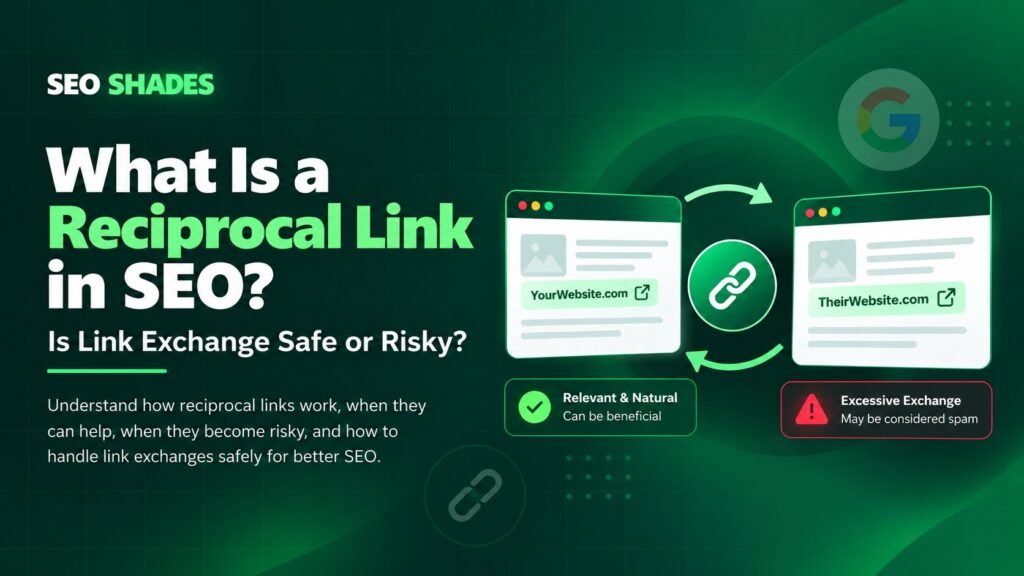
A reciprocal link occurs when two websites link to each other. This practice is commonly known as reciprocal linking or a link exchange.
Let’s understand it with a simple example.
Suppose I run a website called SEO Shades (SEOShades.co.in), and you own another website called Example.com.
Here’s how a reciprocal link exchange would work:
- I publish a blog post on SEO Shades and link to a relevant article on Example.com.
- In return, you publish a blog post on Example.com and link back to SEO Shades.
In this situation, Website A links to Website B, and Website B links back to Website A.
That’s reciprocal linking.
In simple words, you link to my website, and I link to yours.
However, there’s one important distinction to understand. Two websites linking to each other isn’t automatically a violation of Google’s guidelines. The real concern is whether the links are editorially justified or created primarily to manipulate search rankings.
If both links provide useful information to readers, the arrangement may be perfectly natural. If the links exist only because both website owners want to exchange ranking signals, the situation becomes more questionable.
A Practical Example of Reciprocal Linking
Let’s take an example from the digital marketing industry.
Suppose your website focuses on digital marketing, while my website provides web development services.
You publish an article titled “How to Improve Website Speed.” While explaining website performance, you link to my guide on conducting a website performance audit because it provides additional information your readers need.
Later, I publish an article about website maintenance. Within that article, I link to your SEO audit checklist because my readers can use it to identify technical and on-page SEO issues.
Both links have a clear purpose. They connect related topics and help readers find additional resources.
This is a good example of how reciprocal links can occur naturally.
Now, consider a different situation.
We agree to exchange backlinks simply because we both want to improve our Google rankings. Neither website has a genuine editorial reason to link to the other, but we insert the links anyway to increase our backlink counts.
The arrangement now has a different purpose.
The first example focuses on helping users. The second focuses on influencing search rankings.
That’s the difference between natural cross-linking and manipulative link exchange.
When evaluating a reciprocal link, don’t focus only on whether the other website links back to you. Ask yourself whether the link makes sense for the article and whether readers benefit from clicking it.
Related Post : Backlinks Not Getting Indexed? Can You Save Your SEO Job?
Are Reciprocal Links Good for SEO?
The answer depends on the circumstances.
Relevant backlinks can help users discover useful content, connect related resources, and provide additional context about a topic. Links can also contribute to how search engines discover and evaluate pages.
However, a reciprocal link doesn’t automatically provide an SEO benefit simply because two websites have linked to each other.
Google evaluates links within a broader system. The relevance of the content, the context of the link, the way it was created, and whether it complies with Google’s spam policies all matter.
This is why building an SEO strategy around backlink exchanges alone isn’t a good approach.
Instead, focus on several areas together:
- Quality content: Publish information that answers real questions and gives readers a reason to trust your website.
- Topical relevance: Earn links from pages and websites that make sense for your subject and audience.
- Technical SEO: Make sure search engines can crawl and understand your important pages.
- Naturally earned backlinks: Create resources that other website owners want to reference because they provide genuine value.
- A useful user experience: Make it easy for visitors to navigate your website and find relevant information.
Reciprocal linking can happen as part of a natural linking ecosystem, but it shouldn’t become the foundation of your link-building strategy.
The goal isn’t to exchange as many links as possible. It’s to build a website that deserves relevant references.
When Can Reciprocal Links Become Link Spam?
This is where website owners need to be careful.
Google’s spam policies identify excessive link exchanges and partner pages created exclusively for cross-linking as examples of link spam.
In other words, the problem isn’t simply that two websites link to each other. The problem arises when link exchanges are used excessively or systematically to manipulate search rankings.
Let’s look at a practical example.
Imagine you contact 100 website owners and send each of them the same message:
“Give me a backlink, and I’ll give you one in return.”
You then start adding links to all 100 websites across your articles, regardless of whether those websites are relevant to the content or useful to your readers.
If those links are being placed primarily to manipulate Google’s ranking systems, this pattern can create a link spam risk.
The situation becomes even more concerning when reciprocal linking turns into a large-scale activity with little editorial judgment.
For example, you might create dedicated partner pages whose primary purpose is to list websites that have agreed to exchange links. If those pages exist exclusively to facilitate cross-linking for SEO, they may fall within Google’s examples of link spam.
The important point is that not every reciprocal link leads to a Google penalty.
A legitimate reference between two relevant websites is different from a deliberate scheme to manipulate rankings. Google can evaluate links in their context and apply its spam policies accordingly.
Don’t assume that every reciprocal link is dangerous. At the same time, don’t assume that exchanging links with dozens or hundreds of websites is safe simply because the links are technically relevant.
The intent and overall pattern matter.
How to Handle Reciprocal Links Safely
If you’re working on SEO for your own website or managing link building for clients, you don’t need to avoid every website that links back to you.
What you need is a sensible approach to evaluating and placing links.
Here are five practical ways to handle reciprocal linking.
1. Prioritize Relevance
Before linking to another website, check whether the page is relevant to your content and audience.
For example, if you’re publishing an article about technical SEO, linking to a useful guide on website crawling, indexing, or performance makes sense.
On the other hand, linking to an unrelated website just because its owner has agreed to return the favour doesn’t make much editorial sense.
Relevance helps you make better decisions about which resources deserve to be referenced.
Don’t exchange links just because another website has a good-looking domain authority score or promises to give you a backlink in return.
First, ask whether the page is genuinely useful for your readers.
Related Post : 2000+ Social Bookmarking Sites: Best Platforms for SEO
2. Don’t Add Links Just to Complete an Exchange
One common mistake in link building is treating every backlink opportunity as a transaction.
Someone agrees to link to your website, so you feel obligated to add a link to theirs, even when it doesn’t fit your content.
This approach can lead to unnatural links and a poor experience for readers.
A reciprocal link should have a clear editorial reason to exist. If the other website doesn’t provide relevant information, you don’t need to add its link merely to fulfil an agreement.
For example, if another website publishes a detailed guide that genuinely supports a point in your article, linking to it may be useful. If the only reason for including that link is to receive a backlink in return, reconsider the decision.
A backlink exchange shouldn’t override your editorial judgment.
Your responsibility is to publish helpful content, not to make sure every link-building partner receives something in return.
3. Avoid Excessive Link Exchanges
You don’t need to exchange backlinks with every website owner who contacts you.
In fact, limiting your strategy to reciprocal linking can distract you from more valuable SEO activities, such as creating original resources, improving existing content, and earning editorial mentions.
Be particularly cautious of arrangements involving large numbers of websites, repeated reciprocal linking agreements, or partner pages designed mainly to exchange links.
Instead of measuring your progress by the number of exchanges completed, evaluate whether your link-building efforts are helping your website attract relevant visitors and build genuine authority.
A smaller number of genuinely useful references can be more valuable to your audience than a large collection of links added without a clear purpose.
The objective is not to avoid every reciprocal link. It’s to avoid making link exchange the primary reason your website receives or gives links.
4. Handle Paid Links and Other Compensation Properly
Reciprocal linking and paid linking are different practices, but they can overlap in some arrangements.
For example, a website might receive money, products, services, or another form of compensation in exchange for publishing a link.
Google’s link spam policies require qualifying certain compensated links appropriately. For paid placements, the rel=”sponsored” attribute is the recommended option.
For example:
<a href="https://example.com/" rel="sponsored">Read the guide</a>This attribute helps identify the link as sponsored.
The same principle applies when a link is part of a compensated arrangement rather than an independent editorial recommendation. Don’t treat a paid link as an ordinary editorial link simply because it appears within a blog post.
If a link has a commercial purpose, handle it transparently and follow Google’s applicable link qualification guidelines.
Remember that a straightforward reciprocal link exchange isn’t automatically a paid link. However, if money, products, services, or other compensation are involved, evaluate the arrangement separately.
5. Focus on Natural Link Building
This is the most important point.
Instead of spending all your time asking website owners to exchange backlinks, invest in creating content that other websites genuinely want to reference.
For example, you could publish:
- Original research supported by useful data.
- Detailed guides that solve specific problems.
- Industry insights based on practical experience.
- Free tools and resources that help people complete a task.
- Checklists that make complicated processes easier to follow.
- Helpful explanations of technical concepts that are difficult for beginners to understand.
Think about what would make another website owner cite your article without expecting a backlink in return.
If your content provides a useful answer, supports an argument, or offers information that readers can’t easily find elsewhere, it has a stronger reason to earn references.
Natural link building takes time. You may not see results immediately, and not every useful article will attract backlinks. But publishing genuinely helpful resources gives you a better foundation than relying entirely on link exchange agreements.
Related Post : 1100+ Free Profile Creation Sites for SEO in 2026
The goal isn’t just to collect backlinks. It’s to create content that deserves to be referenced.
Reciprocal Linking vs. Natural Link Building
To make the distinction clearer, here’s how the two approaches compare.
| Factor | Natural Reciprocal Linking | Manipulative Link Exchange |
| Primary purpose | Help readers discover relevant resources | Influence search rankings through link exchanges |
| Link relevance | Links fit the content and audience | Links may be added mainly to fulfil agreements |
| Editorial judgment | Each link is evaluated on its usefulness | Links are placed because an exchange was agreed upon |
| Scale and pattern | Cross-linking occurs naturally when appropriate | Exchanges may become excessive or systematic |
| SEO risk | Not inherently a violation of Google’s policies | May violate Google’s link spam policies |
| Recommended approach | Link when it provides genuine value | Avoid ranking-focused exchange schemes |
The distinction is not that one website links back while another doesn’t. Natural linking can be reciprocal, too.
What matters is the purpose of the links and the circumstances in which they are created.
A Simple Checklist Before Exchanging Backlinks
Before agreeing to a reciprocal link, ask yourself these questions:
- Is the other website relevant to my content or audience?
- Does the specific page provide useful information to my readers?
- Would I still link to this page if the website owner weren’t offering a backlink in return?
- Am I making this decision for editorial reasons or primarily to influence rankings?
- Is this part of an excessive or systematic link exchange arrangement?
- Does the link involve payment or other compensation that requires appropriate qualification?
If you can’t justify a link without referring to the backlink you’ll receive in return, take another look at the arrangement.
This checklist isn’t a guarantee that Google will treat a link in a particular way. It’s a practical way to make more informed link-building decisions and avoid arrangements that serve search rankings at the expense of users.
Final Thoughts
Reciprocal linking is a straightforward concept: two websites link to each other.
The practice itself isn’t automatically spam, and there’s no need to remove a useful link simply because the other website also links back to you.
However, excessive link exchanges and arrangements created primarily to manipulate Google rankings can violate Google’s link spam policies.
That’s why I wouldn’t recommend building your entire SEO strategy around backlink exchanges.
Prioritize relevant links, maintain editorial judgment, avoid excessive exchanges, qualify compensated links appropriately, and invest in content that deserves to earn references.
Before adding any backlink, ask yourself one simple question:
Is this link genuinely useful to my readers, or am I adding it only because I want another backlink?
That question can help you make better decisions about reciprocal linking and your overall link-building strategy.
If you’re working on SEO, don’t focus only on the number of backlinks your website has. Pay attention to the quality of your content, the relevance of the links you earn, and the value your website provides to its audience.
At SEO Shades, the goal is to understand SEO concepts practically and use them to improve organic visibility.
Have you ever exchanged backlinks for your website? What was your experience?
Share your thoughts in the comments, and keep following SEO Shades for more practical guides on SEO, link building, and Google rankings.
Frequently Asked Questions (FAQs) About Reciprocal Links
1. What is a reciprocal link in SEO?
A reciprocal link is created when two websites link to each other. For example, Website A links to Website B, and Website B links back to Website A.
2. Are reciprocal links bad for SEO?
No, reciprocal links are not inherently bad for SEO. When links are relevant and provide value to users, they can occur naturally. However, excessive link exchanges designed to manipulate search rankings may violate Google’s spam policies.
3. Does reciprocal linking improve Google rankings?
Reciprocal linking does not guarantee higher Google rankings. Search engines evaluate links within a broader context, including their relevance, quality, and how they were created.
4. Can Google penalize a website for reciprocal linking?
Google may take action against websites that engage in excessive link exchanges intended to manipulate search rankings. However, a website does not automatically receive a penalty simply because it has reciprocal links.
5. How can I build reciprocal links safely?
Prioritize relevant websites, link to genuinely useful resources, avoid excessive exchanges, and focus on earning natural backlinks through high-quality content. Always make editorial decisions based on user value rather than backlink quantity.



Comments
No comments yet. Be the first to share your thoughts or ask a question.