What is Digital Marketing?
Digital marketing is the use of online channels like search engines, social platforms, email, and websites to attract, engage, and convert users.
What this really means is simple. If your audience is online, and your visibility, trust, and sales depend on how effectively you show up across these digital channels.
Unlike traditional marketing, digital marketing is measurable, targeted, and adaptable in real time.
You can track performance, adjust campaigns, and scale what works.
So , if you don’t know what Digital marketing is? Then this complete guide for you to explore different types of digital marketing in 2026.
Why Understanding Types of Digital Marketing Matters
Here’s the thing. Not every digital channel works the same, and using all of them blindly often wastes time and budget.
Understanding the types of digital marketing in 2026 helps you match the right channel with the right goal.
For example:
- Local business → Local SEO + Google Ads
- E-commerce → PPC + influencer marketing
- B2B services → SEO + LinkedIn marketing
The difference between growth and wasted spend usually comes down to choosing the right mix, not doing everything.
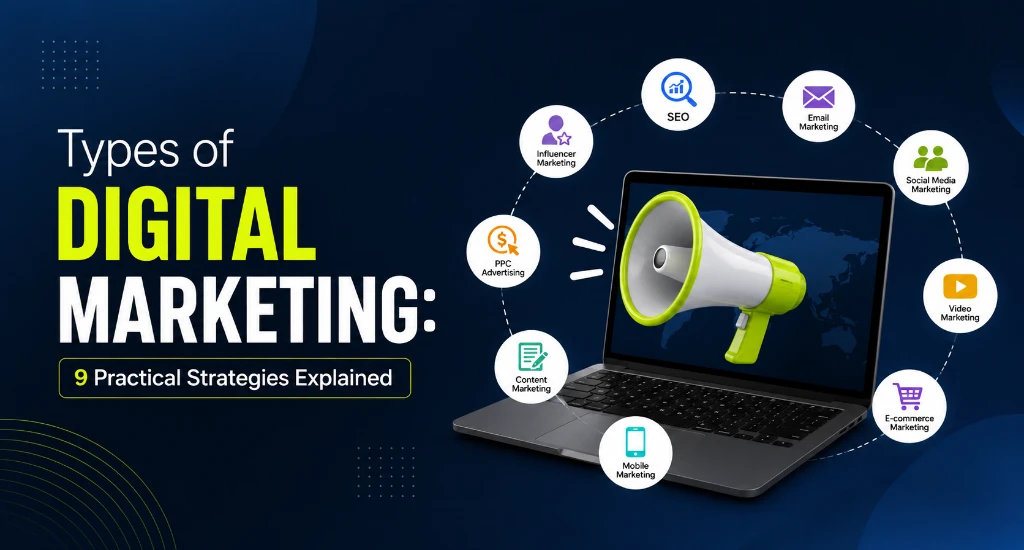
9 Key Types of Digital Marketing Explained
1. Content Marketing
Content marketing focuses on creating useful and valuable content that attracts and engages your audience.
This includes:
- Blog posts
- Videos
- Infographics
- Guides
- Social media content
The goal is not direct selling. It’s building trust first.
Example (India): A coaching institute publishing blog posts on exam tips attracts students organically.
Pros:
- Builds long-term authority
- Improves SEO rankings
- Generates organic traffic
Cons:
- Takes time to show results
- Requires consistency
- Needs strong strategy
If done right, content becomes your biggest asset. This is where a solid content marketing strategy makes the difference.
2. Search Engine Optimization (SEO) and Search Engine Marketing (SEM)
SEO is about ranking your website organically on Google. SEM includes paid ads like Google Ads.
SEO focuses on:
- Keyword optimization
- Technical improvements
- Backlinks
- Content quality
SEM focuses on:
- Paid search ads
- Instant visibility
- Keyword bidding
Example (India): Ranking for keywords like “best SEO services in Delhi” brings high-intent traffic.
Pros:
- SEO brings long-term free traffic
- SEM gives instant results
Cons:
- SEO takes time
- SEM can be expensive
A mix of both usually works best. Many businesses use SEO services in Delhi to dominate local search results.
3. Social Media Marketing (SMM)
Social media marketing uses platforms like:
It includes both organic content and paid ads.
Example (India): D2C brands growing through Instagram reels and influencer collaborations.
Pros:
- Direct audience engagement
- Strong brand building
- Viral potential
Cons:
- Algorithm dependency
- Requires regular content
- Results can be unpredictable
Businesses offering social media marketing services focus on both growth and conversions.
4. Pay-Per-Click Advertising (PPC)
PPC means you pay only when someone clicks your ad.
Popular platforms:
- Google Ads
- Facebook Ads
- YouTube Ads
Example: A local business running Google Ads for “near me” searches.
Pros:
- Instant traffic
- Highly targeted audience
- Measurable ROI
Cons:
- Cost increases with competition
- Requires optimization
- Stops when budget stops
That’s why businesses rely on PPC advertising management to control costs and improve performance.
5. Affiliate Marketing
Affiliate marketing is performance-based. You pay commission for every sale generated through a partner.
Example (India): Amazon affiliates promoting products via blogs or YouTube.
Pros:
- Low upfront cost
- Scalable model
- Pay for results only
Cons:
- Less control over brand messaging
- Risk of fraud
- High competition
Many brands now run structured affiliate marketing programs to scale revenue.
6. Mobile Marketing and Advertising
India is a mobile-first market. Most users access the internet via smartphones.
Mobile marketing includes:
- SMS marketing
- App notifications
- Mobile ads
- WhatsApp marketing
Example: E-commerce apps sending push notifications for sales.
Pros:
- High reach
- Immediate engagement
- Personalized communication
Cons:
- Can feel intrusive
- Limited creative space
- Privacy concerns
Businesses use mobile marketing solutions to tap into this massive audience.
7. Email Marketing
Email marketing is one of the highest ROI channels.
It includes:
- Newsletters
- Promotional emails
- Automated sequences
Example: An e-commerce brand sending discount offers to subscribers.
Pros:
- Low cost
- Highly targeted
- Easy to automate
Cons:
- Spam issues
- Requires email list building
- Open rates vary
Well-optimized email marketing campaigns can drive consistent revenue.
8. Influencer Marketing
Influencer marketing uses individuals with a loyal audience to promote products.
Example (India): Local influencers promoting brands in Hindi or regional languages.
Pros:
- High trust factor
- Strong engagement
- Great for brand awareness
Cons:
- Can be expensive
- Fake followers risk
- ROI tracking can be tricky
Many brands now focus on micro-influencers in influencer marketing India campaigns.
9. Viral Marketing
Viral marketing focuses on content that spreads rapidly through sharing.
Example (India): Zomato and Swiggy social media campaigns.
Pros:
- Massive reach
- Low cost
- High engagement
Cons:
- Unpredictable
- Hard to replicate
- Risk of negative virality
When it works, it works big. But it’s not a reliable long-term strategy
How to Choose the Right Types of Digital Marketing
Let’s break it down clearly.
Step 1: Define Your Goal
- Traffic → SEO, content
- Leads → PPC, email
- Awareness → social, influencer
Step 2: Budget Reality
- Low → SEO + content
- Medium → add social + email
- High → PPC + influencer + full funnel
Step 3: Audience Behavior
- B2B → LinkedIn + SEO
- B2C → Instagram + PPC
- Local → Google + Maps
Step 4: Combine Channels
No single channel scales alone. Real growth comes from combinations.
Measuring Success Across Different Types of Digital Marketing
Tracking performance is what separates guesswork from strategy.
Focus on:
- SEO → rankings, traffic
- PPC → CPC, conversions
- Social → engagement
- Email → open & click rates
- Content → time on page
What this really means:
Track fewer metrics, but track the right ones.
Future Trends in Digital Marketing
- AI-driven personalization
- Voice search optimization
- Short-form video dominance
- Regional content growth
- Data-driven decision making
The shift is clear: marketing is becoming more personalized and data-focused.
FAQs About Types of Digital Marketing
What are the most effective types of digital marketing?
SEO, PPC, and content marketing are the most effective when aligned with business goals.
How many types of digital marketing should I use?
Start with 2–3 core channels and expand based on performance.
Which type is best for beginners?
Content marketing and SEO are the best starting points due to low cost and long-term value.
How long does digital marketing take to work?
SEO takes 3–6 months. PPC and social ads can show results immediately.
Is digital marketing suitable for small businesses?
Yes, especially with SEO, local marketing, and email campaigns.