
Google Helpful Content: How to Create People-First Content That Actually Performs in SEO

Written by Shivam Panchal
Founder & SEO Consultant, SEO Shades
Publishing more articles doesn’t necessarily mean getting more organic traffic. You can have hundreds of blog posts, properly optimized keywords, internal links, backlinks, and well-structured headings, yet your website may still struggle to rank on Google.
At the same time, some websites with comparatively fewer articles perform exceptionally well in search results. So, what makes the difference?
Is Google still looking only at keywords, backlinks, and traditional SEO factors? Or has content quality become a bigger part of the picture?
To understand this, we need to look at Google’s guidance on Helpful, Reliable, People-First Content.
Google wants websites to create content that genuinely helps people rather than content produced primarily to manipulate search rankings. This doesn’t mean SEO is no longer important. It means that SEO should support useful content, not replace it.
In this guide, we’ll explore what People-First Content means, how it differs from Search Engine-First Content, how E-E-A-T works, and how you can evaluate your existing website content using Google’s Who, How, and Why framework.
We’ll also walk through a practical content audit process that you can apply to your own website.
What Is People-First Content?

People-First Content is content created primarily to address users’ needs, answer their questions, and solve their problems.
In simple terms, the focus is on helping the reader rather than simply targeting a keyword.
Let’s understand this with an example.
Suppose someone searches for:
What is Technical SEO?
Now imagine you’re writing a blog post targeting this keyword.
Your objective shouldn’t be to insert the phrase Technical SEO ten or fifteen times throughout the article. Instead, you need to understand what the searcher actually wants to learn.
For example:
- Do they want to understand the definition of Technical SEO?
- Do they want to learn about important technical SEO factors?
- Are they trying to perform a technical SEO audit?
- Are they facing crawling or indexing problems?
- Do they need help fixing technical issues on their website?
These are different user needs, even though they relate to the same topic.
When you understand the actual search intent and create content that addresses those needs, you’re following a People-First Content approach.
Related Post : On-Page SEO: Complete Guide to On-Page SEO Optimization
Four Questions to Evaluate Your People-First Content
Google’s guidance encourages content creators to ask themselves several important questions.
Let’s look at four practical questions you should consider.
1. Does your website have a specific audience?
You should know exactly who you’re creating content for.
Does your target audience genuinely need the information you’re publishing?
For example, if your website focuses on SEO, your audience might include:
- SEO professionals
- Bloggers
- Digital marketers
- Website owners
- Business owners interested in organic growth
Publishing unrelated articles simply because they have high search volume can weaken your website’s primary focus.
Your content strategy should remain relevant to the audience your website intends to serve.
2. Does your content demonstrate first-hand experience?
Collecting information from different websites and rewriting it into a new article isn’t always enough.
If you’re writing about an SEO tool, try to use the tool yourself.
Explain its features, limitations, practical applications, and the situations where it might be useful.
For example, instead of simply describing an SEO tool’s features, demonstrate how you used it, what you discovered, and whether it helped solve a particular problem.
That practical experience gives readers something more valuable than another rewritten description.
3. Does your website have a primary purpose?
Your website should have a clear subject and purpose.
For example, if you operate an education consultancy website, its primary purpose should be to help students understand education opportunities, admission processes, eligibility requirements, and related information.
Publishing content on completely unrelated subjects just to attract additional traffic may take your website away from its core purpose.
4. Will readers feel satisfied after reading your article?
Consider someone searching for:
How to Fix Indexing Issues in Google Search Console
After reading your article, will the person understand why indexing problems happen?
Will they know how to identify possible causes?
Have you explained the troubleshooting steps needed to resolve the issue?
If readers still need to visit several other websites to find the basic information missing from your article, your content may not have fully addressed their needs.
This is one of the most important ideas behind People-First Content.
Your objective should be to provide information that helps users understand a problem and take the next step.
People-First Content vs Search Engine-First Content
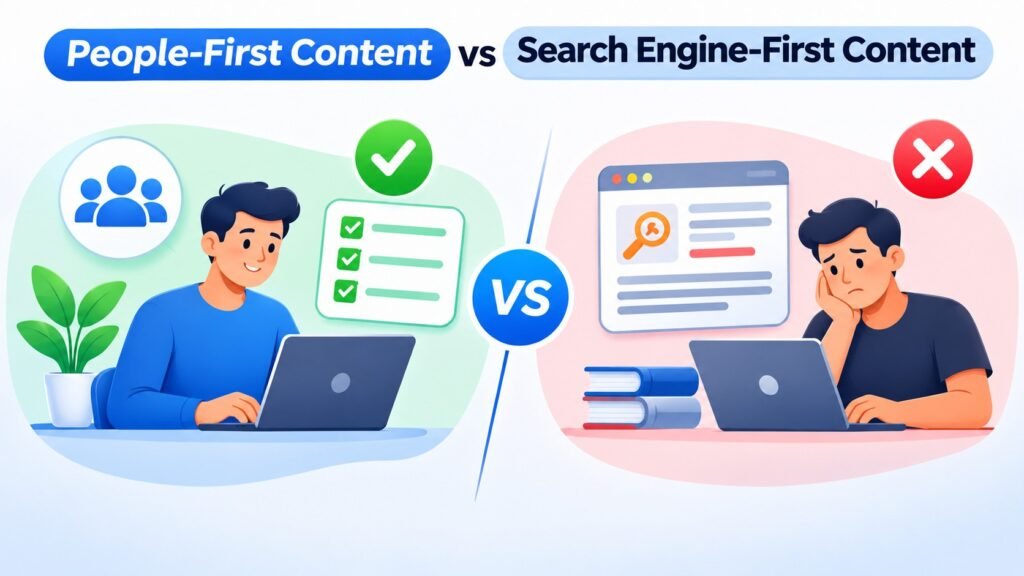
Now that we understand People-First Content, let’s look at its opposite: Search Engine-First Content.
Search Engine-First Content is primarily created to attract search engine traffic and achieve rankings rather than fulfil users’ actual needs.
Here’s a practical example.
Suppose you’ve completed keyword research and discovered that Best SEO Tools has good search volume.
You decide to publish an article targeting this keyword.
There are two ways you can approach it.
Approach 1: Create content by collecting existing information.
You visit different websites, collect information about 20 SEO tools, rewrite their descriptions, and publish a lengthy article.
Approach 2: Create content through research and practical evaluation.
You evaluate the tools, explain their features, compare their pricing, discuss their limitations, and help readers understand which tool might be suitable for different types of users.
The difference is important.
In the first approach, you’re mainly repeating information that already exists.
In the second approach, you’re adding value through research, experience, comparison, and analysis.
Google’s helpful content guidance highlights several warning signs that content creators should avoid.
1. Creating Content Only to Attract Search Traffic
Finding a keyword with high search volume doesn’t automatically mean you should create an article about it.
Before targeting a keyword, consider whether the topic is relevant to your audience.
If you’re publishing an article only because a keyword has high search volume, but the information doesn’t provide meaningful value to your target audience, it’s worth reconsidering your content strategy.
Keyword opportunities should support your website’s purpose, not dictate it entirely.
2. Publishing Content Across Too Many Unrelated Topics
Some websites continuously publish articles about completely different subjects without following a clear content strategy.
The objective is simple: target as many keywords as possible and hope that some pages start receiving organic traffic.
However, publishing more topics doesn’t automatically make a website more useful.
Content relevance and usefulness are more important than simply increasing the number of published pages.
Your website should have a clear subject area and a consistent audience.
3. Using Extensive Automation Without Quality Control
Automation and AI can help content creators save time.
However, problems can arise when websites automatically generate hundreds of articles and publish them without proper human review, research, or quality checks.
AI-generated content isn’t automatically bad.
The real concern is using automation to produce large amounts of content without adding original value, demonstrating expertise, or checking accuracy.
Every article should be reviewed to ensure it provides useful information and meets the expectations of its target audience.
4. Rewriting Information From Other Websites
Imagine searching for a topic and finding ten articles that explain exactly the same information.
Now imagine your article simply repeats those explanations with slightly different wording.
Why should readers choose your website?
If you’re not adding new insights, practical examples, original research, or useful analysis, your content may offer little additional value.
Competitor research is useful, but copying the information structure and rewriting existing explanations shouldn’t be your entire content creation strategy.
5. Increasing Word Count Without Adding Value
A common misconception among SEO professionals is that an article must contain 1,500, 2,000, or even 3,000 words to rank on Google.
But there is no universally preferred word count for Google Search.
An article with 500 words can be useful if it completely addresses the user’s question. Similarly, a 3,000-word article can be valuable when the topic genuinely requires detailed explanations.
The important question isn’t how long your article is.
It’s whether the content satisfies the user’s needs.
Adding unnecessary paragraphs just to increase word count doesn’t improve content quality.
6. Changing Publication Dates Without Meaningful Updates
Another practice seen across many websites is changing an article’s publication date to make it appear fresh.
However, simply updating the date without making substantial improvements doesn’t create genuine freshness.
If an article contains outdated statistics, incorrect information, or missing explanations, update those elements properly.
Similarly, deleting or replacing old articles just to make a website look fresh isn’t a meaningful content strategy.
The focus should be on improving the actual information, not changing dates.
Remember: The objective of content publishing shouldn’t be to get more pages indexed. It should be to create content that people genuinely want to read, understand, and use.
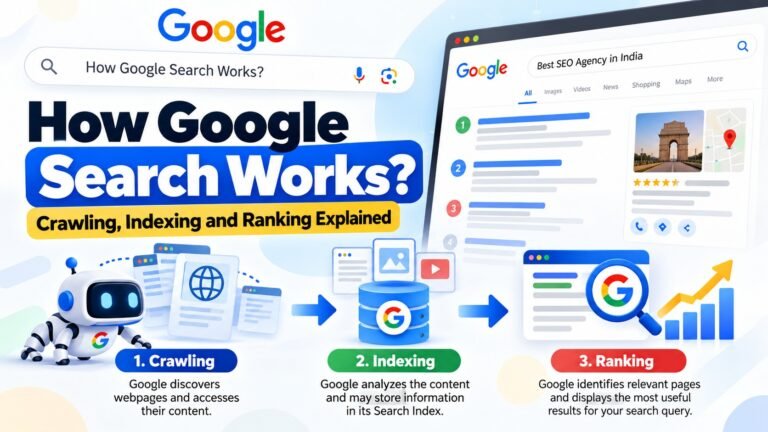
Related Post : How Google Search Works: Crawling, Indexing and Ranking Explained
Does SEO Conflict With People-First Content?
This is a common question.
If Google wants People-First Content, does that mean traditional SEO practices are no longer important?
Absolutely not.
SEO and People-First Content aren’t opposites.
Google recognizes that SEO can be a helpful activity when applied to content created primarily for people.
You can still optimize your website using established SEO practices, including:
- Writing descriptive and relevant SEO titles.
- Using a proper H1, H2, and H3 heading structure.
- Adding relevant internal links.
- Helping search engines discover and understand your content.
- Using relevant images and other media.
- Fixing technical SEO issues.
- Following Google’s SEO Starter Guide recommendations.
These practices help search engines understand your website and make your content easier to discover.
However, there’s an important distinction.
SEO optimization should help search engines understand useful content. It shouldn’t turn content creation into an attempt to manipulate algorithms.
The right approach is straightforward:
Understand the user’s needs first, create useful content, and then apply SEO best practices.
What Is E-E-A-T in SEO?
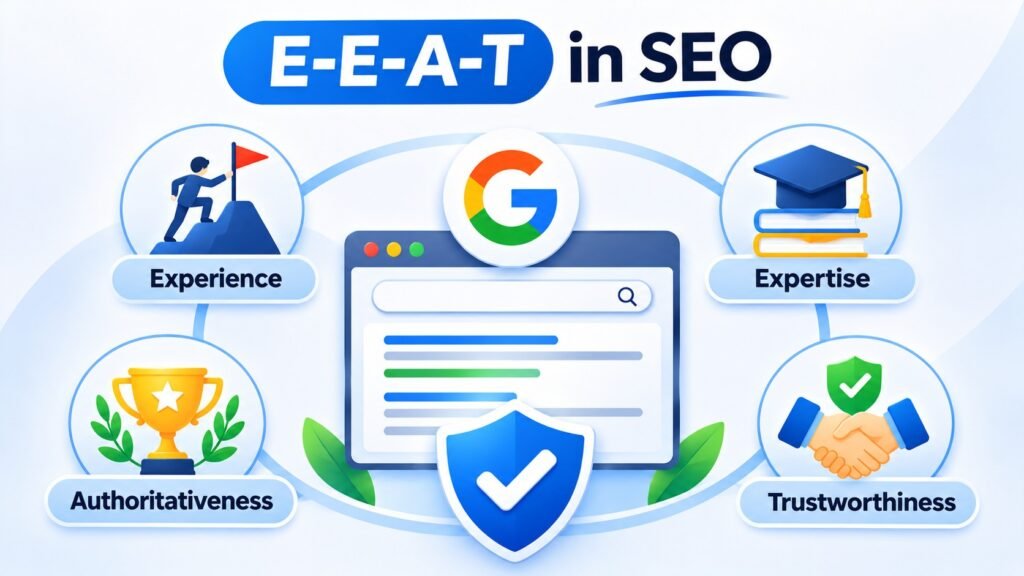
One of the most important concepts connected to Google’s content quality guidance is E-E-A-T.
E-E-A-T stands for:
- Experience
- Expertise
- Authoritativeness
- Trustworthiness
These four elements help explain the qualities Google looks for when evaluating the quality and reliability of content.
Let’s understand each one.
1. Experience
Experience refers to the first-hand knowledge a content creator has about a particular subject.
For example, suppose someone writes a review of an SEO tool.
Have they actually used the tool?
Have they tested its features?
Have they observed its performance?
Have they identified its limitations?
If the article includes real usage examples, practical observations, and genuine insights, it can demonstrate first-hand experience.
Compare two types of content:
- An article that simply describes the features listed on an SEO tool’s website.
- An article that explains how the tool was used, what results were observed, and where it was useful or limited.
The second article gives readers a better understanding of the actual experience.
2. Expertise
Expertise refers to the content creator’s knowledge and understanding of the subject.
Let’s take Technical SEO as an example.
If someone writes about Technical SEO, do they understand:
- Crawling and indexing?
- Canonical tags?
- Robots.txt?
- XML sitemaps?
- Structured data?
- Website rendering?
- Technical website issues?
Are they simply explaining definitions, or can they also help readers understand actual technical problems?
A useful technical SEO article should demonstrate a proper understanding of the topic.
Readers should be able to learn not just what something means, but also why it matters and how it works in practice.
3. Authoritativeness
Authoritativeness is related to the recognition and credibility of a content creator or website within a particular subject area.
For example, imagine a website that has consistently published high-quality educational content about SEO for several years.
Over time, people may start recognizing that website as a useful resource for SEO information.
Its relevant content, reputation, and recognition within the topic can contribute to its authority.
This is why building a focused content strategy and consistently publishing genuinely useful information can be valuable over the long term.
4. Trustworthiness
Trustworthiness is the most important element of E-E-A-T.
A website may demonstrate experience and expertise, but readers still need to trust the information it provides.
Consider the following questions:
- Is the information accurate?
- Can the claims be verified?
- Is the author information genuine?
- Are reliable sources used to support important claims?
- Does the content contain misleading information?
- Is the website transparent about its purpose and ownership?
These factors help establish trust.
A website should not make unsupported claims or present inaccurate information as fact.
Content creators should ensure that their information is reliable and that readers can understand where important information comes from.
Related Post : Google Crawling vs Indexing: Why Your Pages Aren’t Appearing in Search
Is E-E-A-T a Google Ranking Factor?
Here’s something important to understand.
E-E-A-T is not a specific individual ranking factor.
Google uses multiple automated systems and signals to identify different aspects of content quality, including qualities associated with experience, expertise, authoritativeness, and trustworthiness.
Therefore, E-E-A-T shouldn’t be treated as a direct ranking formula or a shortcut to better positions in search results.
Instead, consider it a framework for improving content quality and building user trust.
What Is YMYL in SEO?
Google pays particular attention to content that can affect people’s health, financial stability, safety, or overall well-being.
These subjects are commonly referred to as YMYL (Your Money or Your Life) topics.
Examples include:
- Medical advice and healthcare information.
- Financial planning.
- Loans and investments.
- Legal information.
- Health-related content.
For these subjects, accuracy, expertise, and reliable sourcing are especially important.
For example, if you’re publishing an article about medical treatment, readers should receive accurate information supported by reliable sources.
Similarly, financial articles discussing loans, investments, or financial planning should be carefully researched and fact-checked.
What Is the Role of Google’s Search Quality Raters?
Google also uses Search Quality Raters to evaluate the quality of search results and provide feedback.
However, these raters don’t directly control the ranking of individual websites.
Their feedback is not directly used as an individual website’s ranking score in Google’s algorithm.
This is another reason why E-E-A-T shouldn’t be treated as a ranking hack.
Focus on building genuinely reliable and helpful content rather than trying to optimize for a theoretical E-E-A-T score.
How Does Google Evaluate Content Quality?
When evaluating content quality, there are several important aspects worth considering.
Google’s guidance discusses elements such as effort, originality, skill, and accuracy.
Let’s look at how these apply to practical SEO work.
1. Effort: How Much Work Went Into Creating the Content?
Think about the actual work involved in preparing your article.
Did you conduct research?
Did you perform original analysis?
Did you include practical examples?
Did you test a tool or investigate a real problem?
Did you collect relevant data?
For example, suppose you’re writing an article about Core Web Vitals.
Instead of simply explaining what Core Web Vitals are, you could include:
- Your website’s PageSpeed Insights results.
- The issues identified during testing.
- The improvements you implemented.
- The results observed after making changes.
This demonstrates actual effort and provides readers with practical information.
On the other hand, simply rewriting information from another website doesn’t demonstrate the same level of original work.
2. Originality: Does Your Content Offer Something New?
Originality doesn’t necessarily mean discovering something nobody has ever discovered before.
You can add original value by presenting existing information in a more useful, practical, or understandable way.
For example, consider adding:
- Your own case studies.
- Original screenshots.
- Practical demonstrations.
- Data analysis.
- Insights from your professional experience.
- Comparisons based on actual testing.
These elements help make your article more useful than a basic explanation of an existing topic.
For SEO websites, this can be particularly valuable.
Instead of publishing another generic guide about keyword research, demonstrate how you identify keyword opportunities, analyze search intent, and organize keywords into content clusters.
3. Talent or Skill: How Well Is the Content Created?
Even useful information can become difficult to understand if it’s poorly presented.
Consider the overall quality of your article.
Ask yourself:
- Is the content easy to understand?
- Are the headings organized properly?
- Are the paragraphs readable?
- Are the images and videos relevant?
- Is the information presented professionally?
- Are interactive features useful to readers?
For example, at SEO Shades, an article about schema markup can explain different schema types and how structured data works.
But you can make the experience more useful by providing a Schema Markup Generator that allows users to generate their own schema code.
Instead of only reading about schema markup, visitors can actually use a tool to complete their task.
This is a practical way to improve the usefulness of a website’s content.
4. Accuracy: Is the Information Correct?
Accuracy is essential.
Before publishing an article, verify whether the information is factually correct.
Check:
- Are the statistics accurate?
- Can important claims be verified?
- Are the sources reliable?
- Is the information outdated?
- Are examples technically correct?
- Are recommendations appropriate for the topic?
This becomes especially important when writing about medical, financial, and legal subjects.
Incorrect information in these areas can have serious consequences.
Make fact-checking a regular part of your content publishing process.
Related Post : How to Fix Discovered – Currently Not Indexed in Google Search Console
Google’s Who, How, and Why Framework
Now let’s discuss one of the most practical parts of Google’s helpful content guidance: the Who, How, and Why framework.
Google recommends evaluating content through three important questions.
1. Who created the content?
2. How was the content created?
3. Why was the content created?
Understanding these questions can help you improve transparency, demonstrate experience, and keep your content focused on users.
1. WHO: Who Created the Content?
When someone visits your website and reads an article, can they identify who wrote it?
Consider the following questions:
- Is the author’s name mentioned?
- Is an author profile available?
- Does the profile explain the author’s background?
- Is relevant professional experience mentioned?
- Is the content reviewed by a qualified expert, where appropriate?
For example, if your website publishes SEO articles, including a relevant author profile can help readers understand who is behind the content.
The profile might include:
- SEO experience.
- Professional background.
- Areas of expertise.
- Relevant projects or professional work.
If an article has been reviewed by an expert, you can also provide genuine reviewer information.
However, there’s one important rule.
Never create fake author profiles, false qualifications, or fabricated professional credentials just to make content appear more authoritative.
If someone doesn’t have a particular qualification or professional background, don’t claim that they do.
Authentic information is essential for building trust.
2. HOW: How Was the Content Created?
The second question focuses on the content creation process.
Readers should be able to understand how information was researched, tested, or evaluated when that process is relevant to the content.
Let’s take a product review as an example.
If you’re publishing a review, readers may want to know:
- How many products did you test?
- How did you conduct the testing?
- Which parameters did you use for comparison?
- What results did you observe?
- Do you have original photographs or other evidence?
Similarly, if you’re writing an SEO article, you can explain your research process, practical testing, and data analysis.
This makes your content more transparent and useful.
Can You Use AI to Create SEO Content?
This is an important question for modern content creators.
Is using AI to write articles against Google’s guidelines?
No. Using AI or automation isn’t automatically against Google’s guidance.
The problem arises when websites use these technologies to generate large volumes of content without adding original value, checking accuracy, or providing meaningful human oversight.
AI can assist with several content-related tasks, including:
- Creating an initial content outline.
- Organizing research.
- Identifying missing subtopics.
- Improving readability.
- Preparing an initial draft.
- Checking grammar and structure.
However, the final article still needs proper evaluation.
Check whether the information is accurate, whether the examples are relevant, and whether the article provides something genuinely useful.
Where readers would reasonably want to understand how content was produced, transparency about the use of AI or automation can also be helpful.
The important thing is not whether you used AI.
It’s whether the final content is accurate, original, reliable, and useful.
3. WHY: Why Was the Content Created?
This is arguably the most important question in the entire framework.
Why are you publishing a particular article?
Is your objective to:
- Solve a user’s problem?
- Explain an important subject?
- Share useful information with your audience?
- Help readers make informed decisions?
Or are you publishing the article primarily to attract Google traffic?
Let’s take an example from SEO Shades.
Suppose you’re writing an article about Technical SEO Audits.
The purpose should be to help website owners identify technical issues, understand why those issues matter, and learn how to address them.
However, if you’re only targeting keywords without explaining practical solutions, the article isn’t fulfilling the user’s actual needs.
Here’s a question I recommend asking before publishing any article:
If Google didn’t send a single visitor to this article, would my target audience still want to read it?
Think about this carefully.
If the answer is yes, you’re probably creating content with a meaningful purpose.
If the only reason for publishing the article is to attract organic traffic, you should reconsider its value.
Related Post : How to Optimize Content for Google AI Overviews in 2026
How to Perform a Practical People-First Content Audit
Understanding Google’s guidelines is one thing. Applying them to an existing website is another.
For SEO professionals and website owners, the real challenge is identifying which pages need improvement and what changes should be made.
Here’s a seven-step content audit process you can follow.
Step 1: Check the Purpose of Each Page
Start by preparing a list of important pages on your website.
You can use Google Search Console, Google Analytics, or a website crawling tool to identify the pages you want to review.
For each page, identify:
- Who is the target audience?
- What is the primary purpose of the page?
- Which problem does it solve?
- Is it relevant to your website’s main topic?
For example, if you operate an SEO website, an article about technical SEO audits is relevant to your audience.
However, an unrelated article published only because it has search volume may not fit your website’s primary purpose.
Every important page should have a clear reason to exist.
Step 2: Evaluate Search Intent
Next, identify the search intent behind your target keyword.
Search for the keyword on Google and examine the type of information users are likely looking for.
For example, do they need:
- An informational guide?
- A product or service comparison?
- A practical tool?
- A step-by-step tutorial?
- A solution to a specific problem?
Different search queries require different content formats.
Suppose someone searches for Schema Markup Generator.
A long article explaining the definition of structured data may not be enough.
The user may actually want a tool that generates schema code.
In this situation, providing a functional tool alongside relevant explanations can better satisfy the search intent.
Once you understand the intent, compare your existing article against the user’s actual expectations.
Step 3: Check Whether Your Content Offers Original Value
Read your article carefully and evaluate its originality.
Ask yourself:
- Does the article include original research?
- Are there practical examples?
- Have you included insights from your own experience?
- Is the content simply repeating information from other websites?
- Does the article provide something useful that readers may struggle to find elsewhere?
If your article contains only basic information available across dozens of websites, consider how you can improve it.
You might add an original example, a practical demonstration, a comparison, or an explanation based on your own experience.
The goal is to give readers a genuine reason to choose your article.
Step 4: Review E-E-A-T Elements
Now evaluate the experience, expertise, authority, and trustworthiness demonstrated by your website.
Check the following:
| Area | What to Review |
|---|---|
| Experience | Does the content include genuine practical experience? |
| Expertise | Does the article demonstrate subject knowledge? |
| Authoritativeness | Does the website have relevant recognition and credibility? |
| Trustworthiness | Is the information accurate and reliable? |
| Author Information | Is the author information genuine and relevant? |
| Sources | Are important claims supported by reliable sources? |
| Transparency | Do About and Contact pages provide accurate information? |
Pay particular attention to author information, source quality, and factual accuracy.
Make sure the website represents its authors and expertise honestly.
Step 5: Evaluate Overall Content Quality
Now review the article’s actual presentation and writing quality.
Look for:
- Spelling mistakes.
- Grammar issues.
- Unnecessary paragraphs.
- Repetitive explanations.
- Misleading claims.
- Poorly organized headings.
- Outdated information.
- Missing practical examples.
Improve the structure wherever necessary.
You can also add relevant images, videos, tables, screenshots, or interactive tools when they genuinely help readers understand the topic.
Don’t add media simply to make the page look longer or more attractive.
Every element should serve a purpose.
Step 6: Check the Page Experience
Content quality is important, but readers also need a good experience when accessing your website.
Review the following:
Mobile usability: Does your website work properly on mobile devices?
Readability: Are paragraphs, headings, and other content elements easy to read?
Navigation: Can visitors find important information without difficulty?
Page interruptions: Are unnecessary pop-ups, advertisements, or other interruptions affecting the reading experience?
Loading performance: Does the page load efficiently?
Content accessibility: Can users easily understand and interact with the important elements of the page?
A good website experience is the result of several factors working together.
Make sure users can access and consume your content without unnecessary difficulty.
Step 7: Read the Article From the User’s Perspective
This is one of the simplest but most useful parts of the audit.
Forget that you’re the website owner or SEO professional for a moment.
Imagine you’re a first-time visitor who has searched for the topic on Google.
Now read your article.
Ask yourself:
1. Am I getting answers to all my important questions?
2. Does this article provide practical knowledge?
3. Would I consider sharing this article with someone else?
4. Do I need to visit another website to understand basic information missing from this page?
5. Can I take action after reading this article?
If your article genuinely satisfies the reader’s needs, you’re moving in the right direction.
Related Post : How to Write Human-Written Content: A Complete Guide
Common SEO Mistakes That Hurt Content Quality
While implementing a People-First Content strategy, there are several common mistakes that SEO professionals and website owners should avoid.
Let’s go through them.
Mistake 1: Focusing Only on Keyword Density
Adding the same keyword repeatedly doesn’t automatically make an article helpful.
Your primary focus should be explaining the topic properly.
Use the target keyword naturally and include relevant terminology wherever it makes sense.
Don’t sacrifice readability just to increase keyword frequency.
Mistake 2: Publishing Unnecessary Content
You don’t need to publish five or ten articles every day to build organic traffic.
Publishing frequency alone doesn’t determine content quality.
Focus on creating relevant articles that provide meaningful information to your target audience.
A smaller collection of genuinely useful articles can be more valuable than hundreds of unnecessary pages.
Mistake 3: Copying Competitors
Competitor analysis is an important part of SEO.
You should understand what competitors are publishing, which topics they cover, and what information users expect.
However, simply copying competitor headings and rewriting their paragraphs won’t give your website a unique identity.
Use competitor research to identify opportunities.
Then add your own research, practical examples, and insights to create something more useful.
Mistake 4: Providing Fake Author Information
Never misrepresent an author’s qualifications, professional experience, or expertise.
If someone has five years of SEO experience, you can mention that when it’s accurate.
But don’t invent qualifications or create fake expert profiles to make an article look more credible.
Genuine author information is far more valuable than fabricated credentials.
Mistake 5: Increasing Word Count Unnecessarily
Don’t make an article longer just because you believe longer content ranks better.
Every paragraph should have a purpose.
If a sentence doesn’t explain anything important, answer a question, or add practical value, consider removing it.
Keep the content as detailed as the topic requires.
Mistake 6: Updating Publication Dates Without Making Real Changes
Changing an article’s publication date without updating its actual content doesn’t improve its quality.
If information has become outdated, make meaningful improvements.
Update statistics, correct inaccuracies, add missing information, and improve explanations.
The date should reflect the actual content update rather than being changed simply to create an impression of freshness.
Mistake 7: Publishing AI Content Without Human Review
AI can help with content production, but publishing an AI-generated draft without checking it is a risky approach.
Review the content for:
- Factual accuracy.
- Originality.
- Relevance to the target audience.
- Practical examples.
- Repetitive explanations.
- Missing information.
- Overall usefulness.
Make sure the final article reflects proper research and editorial judgment.
The technology you use matters less than the quality of the content you ultimately publish.
Final Thoughts: Focus on People Before Search Engines
Google’s guidance on Helpful, Reliable, People-First Content makes one thing clear: publishing more content doesn’t automatically create better SEO results.
Adding keywords, increasing article length, and publishing more pages are not enough.
Your content needs to provide genuine value.
Before publishing an article, make sure it:
- Addresses the user’s actual needs.
- Provides original information or meaningful analysis.
- Demonstrates relevant first-hand experience and expertise.
- Contains accurate and reliable information.
- Clearly identifies the author and relevant content creation process.
- Provides a satisfying experience for readers.
Most importantly, understand why you’re creating the content in the first place.
Create content for your users before creating it for Google.
SEO isn’t just about bringing visitors from search engines. Its real value comes when visitors find the right information, understand what they need to know, and accomplish their goals.
If you’re an SEO professional, blogger, or website owner, start by auditing a few important articles on your website.
Evaluate them using the People-First approach discussed in this guide and identify where you can make meaningful improvements.
Keep learning, keep testing, and keep improving your content.
Keep Learning, Keep Growing with SEO Shades!
Frequently Asked Questions About Google Helpful Content
1. What is People-First Content in SEO?
People-First Content is content created primarily to help users by answering their questions, addressing their needs, and solving their problems. It focuses on usefulness, accuracy, relevance, and user satisfaction rather than creating pages solely to improve search rankings.
2. What is the difference between People-First Content and Search Engine-First Content?
People-First Content focuses on satisfying users’ needs through useful and reliable information. Search Engine-First Content is primarily created to attract search traffic and rankings, often without considering whether it provides meaningful value to readers.
3. Is AI-generated content against Google’s guidelines?
No. Using AI or automation to create content isn’t automatically against Google’s guidelines. However, content created at scale without originality, accuracy, human oversight, or additional value can violate Google’s spam policies, depending on how it is produced and used.
4. What does E-E-A-T stand for in SEO?
E-E-A-T stands for Experience, Expertise, Authoritativeness, and Trustworthiness. These concepts help explain the qualities associated with high-quality and reliable content.
5. Is E-E-A-T a direct Google ranking factor?
E-E-A-T is not a single, specific ranking factor. Google uses various systems and signals to evaluate content quality and identify qualities associated with experience, expertise, authority, and trust.




Comments
No comments yet. Be the first to share your thoughts or ask a question.