
Is SEO Dead After Google AI Overviews? How to Optimize Your Website for AI Search in 2026

Written by Shivam Panchal
Founder & SEO Consultant, SEO Shades
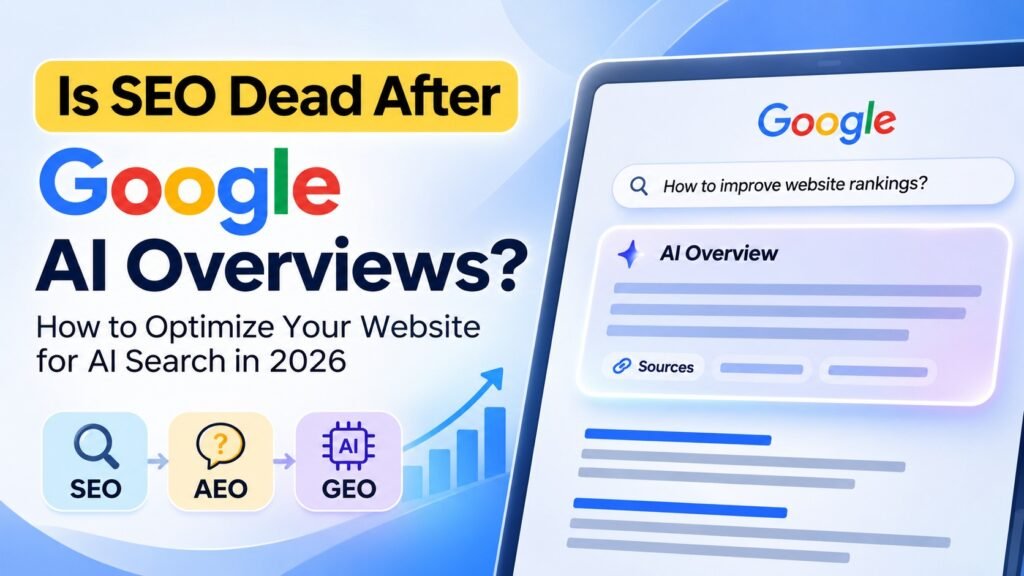
Google Search is going through a major change. For years, the goal of SEO professionals was straightforward: get a website into Google’s top 10 organic search results and attract traffic through those rankings.
But things are changing.
Today, when you search for something on Google, you may see an AI-generated answer before the traditional organic search results. Instead of showing users a list of websites and letting them find the information themselves, Google can now generate a detailed response using information gathered from multiple sources.
This feature is known as Google AI Overviews.
And it raises an important question for website owners, bloggers, and SEO professionals: If Google can answer users’ questions directly, why would anyone visit our websites?
Does this mean organic traffic will decline? Is traditional SEO becoming less important? Should we stop focusing on SEO and start investing in AEO (Answer Engine Optimization) and GEO (Generative Engine Optimization)?
These are genuine concerns, especially for businesses that depend on organic search traffic.
However, based on Google’s official documentation, the situation is not as complicated as many people in the SEO industry are making it sound.
Google is introducing new AI-powered search experiences, but the fundamentals of SEO are still relevant. What is changing is how users discover information and how Google presents that information in search results.
In this article, I’ll explain how Google AI Overviews and AI Mode work, what Google expects from website owners, and what practical steps you should take to prepare your website for AI Search in 2026.
Let’s get into it.
Is SEO Dead After the Introduction of AI Search?
Let’s clear up the biggest misconception first.
There is a lot of discussion in the SEO industry about how AI Search will replace traditional SEO. Some people believe that ranking in traditional organic search results will become less important and that website owners should focus entirely on GEO.
But Google’s official guidance tells a different story.
According to Google, traditional SEO best practices remain relevant for its generative AI search experiences, including AI Overviews and AI Mode.
What does this mean for website owners?
If you’re already publishing helpful content, maintaining your website’s technical health, improving internal linking, and solving users’ problems, you don’t need to completely rebuild your SEO strategy.
Google’s AI-powered search experiences are connected to its existing Search infrastructure and quality systems.
This is an important distinction.
AI Search and traditional Google Search are not two completely separate systems. Google’s search infrastructure helps retrieve relevant information, while generative AI capabilities help organize and present that information in a conversational format.
So, SEO isn’t dead.
However, the way people search for information and discover websites is changing.
Earlier, a user might search for a question, visit several websites, compare the information, and find an answer.
Now, Google may provide an AI-generated summary directly on the search results page, with links to relevant sources.
This means website owners need to think beyond traditional keyword rankings. Visibility within AI-generated responses is becoming another part of the search experience.
Related Post : Google Helpful Content: How to Create People-First Content That Actually Performs
How Do Google AI Overviews and AI Mode Work?
Before discussing how to optimize a website for AI Search, it’s important to understand how these features work.
Google’s documentation discusses two important concepts that help explain its generative AI search experiences:
- Retrieval-Augmented Generation (RAG)
- Query Fan-Out
Let’s understand both with practical examples.
What Is Retrieval-Augmented Generation (RAG)?
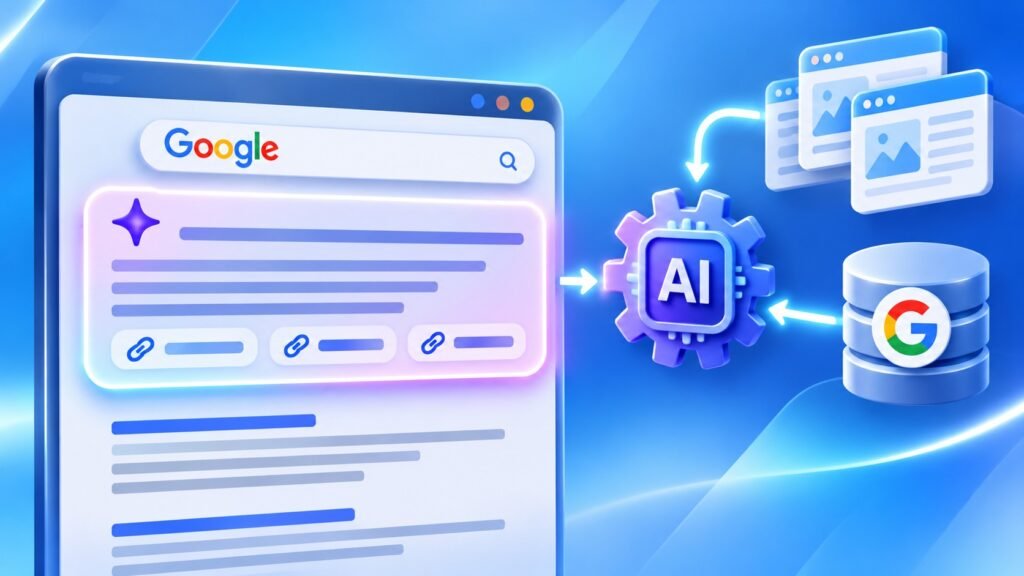
Retrieval-Augmented Generation, commonly known as RAG, is a process in which an AI system retrieves relevant information from external sources and uses that information to generate a response.
Let’s say someone searches on Google:
How can I improve my website’s organic traffic?
An AI system doesn’t necessarily need to generate the entire answer using only information stored in its existing knowledge.
Instead, Google’s systems can retrieve relevant webpages from its Search Index.
The information available on those webpages can then be used to help generate an answer that addresses the user’s question.
This is the basic idea behind Retrieval-Augmented Generation.
For website owners, there’s an important opportunity here.
Your website may appear not only in traditional organic search results but also as a supporting source within AI-generated answers.
Google can display clickable links alongside AI-generated responses, allowing users to explore the original sources for more information.
This is why creating useful, accessible, and relevant content still matters.
What Is Query Fan-Out in Google AI Search?
The second concept is Query Fan-Out.
This is particularly interesting from an SEO perspective because it changes how we should think about search queries and content coverage.
Let’s take an example.
Suppose someone searches:
How to fix a lawn full of weeds?
Instead of looking at this as just one question, Google’s AI systems may explore several related searches to understand the topic more comprehensively.
These could include:
- Best herbicides for lawns.
- How to remove weeds without chemicals.
- How to prevent weeds from growing again.
These related queries help the system explore different aspects of the original question.
The important SEO takeaway is that your content shouldn’t focus only on one exact-match keyword.
You should also understand the related concepts, questions, and problems that users may have around that topic.
For example, if you’re writing an article about improving organic traffic, you might also need to cover:
- How to identify traffic drops.
- How to improve keyword rankings.
- How to find technical SEO issues.
- How to improve existing content.
- How to measure organic traffic growth.
However, this doesn’t mean you should start publishing a separate article for every small variation of a keyword.
The goal is to provide complete and useful information, not to create hundreds of unnecessary pages.
Unique and Valuable Content Is More Important Than Ever

Now let’s discuss what I believe is one of the most important parts of preparing a website for AI Search: content quality.
If you want your website to gain visibility in Google Search and its AI experiences, you need to pay attention to the actual value your content provides.
But simply publishing more articles isn’t going to solve the problem.
Think about it.
Suppose you run an SEO blog and decide to publish an article on:
How to Improve Website Rankings?
You write ten common SEO tips that are already available on thousands of websites.
Your article explains keyword research, backlinks, meta descriptions, internal linking, and technical SEO.
But here’s the real question:
Why should someone visit your website when they can find the same information on hundreds of other websites?
This is something you should ask yourself before publishing every article.
Google’s guidance emphasizes creating helpful, reliable, people-first content. Unique perspectives and first-hand experience can make your content more useful and distinguish it from generic information.
Share Your Real SEO Experience
Let’s say you’ve performed a technical SEO audit for a website and discovered an interesting indexing issue.
Instead of writing another generic article explaining what technical SEO is, share what you actually discovered.
Explain:
- What the technical issue was.
- How you identified it.
- Which tools you used.
- What steps you took to fix it.
- What happened after implementation.
Similarly, if you’ve worked on improving a website’s organic traffic, share your observations and strategy.
You can discuss the changes you made, the challenges you faced, and the results you observed.
If you’ve implemented a particular SEO technique, explain what worked and where you faced problems.
This type of content gives readers something more valuable than basic information. It gives them practical insights based on real experience.
And that’s the difference between an ordinary article and genuinely useful content.
Related Post : How Google Search Works: Crawling, Indexing and Ranking Explained
Write for Human Readers, Not Just Search Engines
Another important thing is content organization.
Your article should have:
- Clear and descriptive headings.
- Logically organized sections.
- Readable paragraphs.
- Relevant examples.
- Easy-to-understand explanations.
- Useful internal links.
Don’t make readers work hard to find the information they’re looking for.
If you’re explaining a complicated SEO process, break it into understandable steps.
Use Relevant Images and Videos
Visual content can also improve the reading experience.
For example, suppose you’re explaining how to identify indexing issues in Google Search Console.
Instead of explaining everything through text, add relevant screenshots showing where users can find the necessary reports and settings.
You can also use diagrams, short videos, and other visuals whenever they make a concept easier to understand.
The objective isn’t to add images just to make an article look attractive. Every visual should serve a purpose.
Most importantly, remember one thing:
Your goal should not be simply to publish another article. Your goal should be to solve the user’s problem.
Is Using AI to Write Content Against Google’s Guidelines?

This is another question that comes up frequently in the SEO industry.
Can Google penalize a website for publishing AI-generated content?
The answer is more nuanced than a simple yes or no.
According to Google’s guidance, using generative AI tools to create content isn’t automatically against its policies.
You can use AI tools for:
- Content research.
- Topic brainstorming.
- Creating article outlines.
- Organizing information.
- Preparing initial drafts.
- Improving content structure.
The problem starts when website owners use AI to generate large volumes of low-quality pages without adding meaningful value.
Let’s understand this with an example.
Suppose you’ve used a keyword research tool and collected 500 keywords for your website.
You then give an AI tool a prompt asking it to write one article for every keyword.
The AI generates 500 articles, and you publish all of them without proper review, expertise, original research, or additional information.
This approach can create serious problems.
Google’s scaled content abuse policy addresses the production of large amounts of unoriginal content primarily to manipulate search rankings, regardless of whether that content is produced using AI, automation, or human writers.
In other words, the issue isn’t simply whether AI was involved.
The issue is whether you’re publishing content at scale without providing genuine value to users.
How Should SEO Professionals Use AI?
My recommendation is simple: use AI as your content assistant, not as a complete replacement for your knowledge and experience.
For example, you can use AI to prepare an article outline, identify questions worth covering, organize research, or improve readability.
But before publishing, review the content carefully.
Add your own insights, verify factual information, include relevant examples, and make sure the final article actually answers the user’s question.
AI can help you work faster, but you’re still responsible for the quality of what gets published on your website.
Technical SEO Is Still Essential for AI Search

Some SEO professionals believe that technical SEO will become less important as AI-powered search grows.
I don’t agree with that.
In fact, maintaining your website’s technical health is still an important part of building search visibility.
Google’s documentation explains that websites need to meet the relevant technical requirements for their content to be eligible for inclusion in AI-powered search experiences.
For example, a webpage needs to be indexed by Google and eligible to appear with a snippet in Search.
Let’s look at the technical SEO areas you should regularly check.
Crawling and Indexing
First, make sure Googlebot can access your important webpages.
Check whether your robots.txt file is accidentally blocking important sections of your website.
Also, review your indexing status in Google Search Console.
Pay attention to:
- Important pages that aren’t indexed.
- Pages blocked by robots.txt.
- URLs containing noindex directives.
- Server errors.
- Redirect issues.
- Pages discovered but not indexed.
Your important URLs should be accessible to Google and properly included in its index.
Remember, publishing a good article doesn’t automatically mean Google will index it.
You need to make sure there are no technical barriers preventing Google from discovering and processing your content.
Maintain a Clear Website Structure
Your website should have a logical structure that makes navigation easy for both users and search engines.
For example, if you run an SEO website, you can organize your content into categories such as:
- Technical SEO.
- On-Page SEO.
- Off-Page SEO.
- Keyword Research.
- SEO Tools.
- Google Updates.
Use relevant internal links to connect related articles.
For instance, an article about technical SEO audits can link to relevant articles about crawling, indexing, canonical tags, robots.txt, and XML sitemaps.
This creates meaningful connections between your pages and helps users explore related topics.
Your URL structure should also remain clean and logical.
Pay Attention to JavaScript SEO
If your website is built using a JavaScript framework, you should check whether Google can properly process your important content.
Google can process JavaScript content, but that doesn’t mean every JavaScript implementation will work perfectly from an SEO perspective.
Rendering problems, blocked resources, incorrect internal links, and dynamically loaded content can create indexing and visibility issues.
Check whether:
- Important content is available to Google during rendering.
- Internal links use crawlable URLs.
- Important pages don’t depend on inaccessible scripts.
- Metadata is correctly rendered.
- Canonical tags are implemented properly.
JavaScript SEO can be more complicated than traditional HTML SEO, so regular testing is important.
Improve Page Experience
Your website should work properly on both mobile and desktop devices.
Users shouldn’t have to wait unnecessarily for the main content to load or struggle with confusing navigation.
Focus on:
- Mobile responsiveness.
- Core Web Vitals.
- Loading performance.
- Visual stability.
- Easy navigation.
- Clear content presentation.
A technically functional website creates a better experience for visitors and supports your overall SEO efforts.
Fix Duplicate Content and Canonicalization Issues
Duplicate URLs can make it difficult to maintain a clean website structure.
For example, the same content might be accessible through multiple URL variations because of tracking parameters, pagination, or inconsistent URL handling.
Use canonical tags where appropriate to indicate the preferred version of a page.
Also, maintain consistent internal linking and avoid unnecessary duplicate pages.
The main point is straightforward.
If Google cannot properly crawl, process, and understand your website, even high-quality content may struggle to achieve its full search potential.
Related Post : Google Crawling vs Indexing: Why Your Pages Aren’t Appearing in Search
Do You Need LLMs.txt and Special AI Schema Markup?
Let’s discuss some of the SEO practices that have gained attention with the growth of AI Search.
One example is llms.txt.
Some SEO professionals recommend creating an LLMs.txt file because they believe it will help websites become more visible in AI-powered search engines.
Others recommend implementing special AI schema markup.
But what does Google actually say?
According to Google’s official guidance, you don’t need to create special files such as LLMs.txt to appear in Google’s generative AI search experiences.
Google doesn’t provide special AI Search preference simply because a website has this file.
You can maintain such files if they’re useful for other AI systems or services, but creating one solely to improve Google rankings isn’t necessary.
Is Content Chunking Required for AI Search?
Another concept discussed in the SEO industry is content chunking.
The idea is that you should divide every paragraph into very small sections so AI systems can understand your content more easily.
However, Google doesn’t require a specific content chunking format for its AI search features.
You should organize your content according to what makes the most sense for your audience.
Use meaningful headings, logical sections, and readable paragraphs.
There’s no need to force every paragraph into an artificial structure just because someone claims it’s an AI SEO requirement.
Should You Create a Separate Article for Every Long-Tail Keyword?
No, not necessarily.
Suppose you’re writing about technical SEO audits.
You may have several related keywords:
- Technical SEO audit.
- How to perform a technical SEO audit.
- Technical SEO checklist.
- Technical SEO audit tools.
- Website technical issues.
You don’t necessarily need five separate articles for these queries.
A comprehensive, well-structured article may cover several related questions effectively.
What matters is search intent and the usefulness of the information.
If two queries have different search intents and require genuinely different solutions, separate articles may make sense.
But creating multiple pages simply to target every keyword variation can lead to unnecessary content duplication.
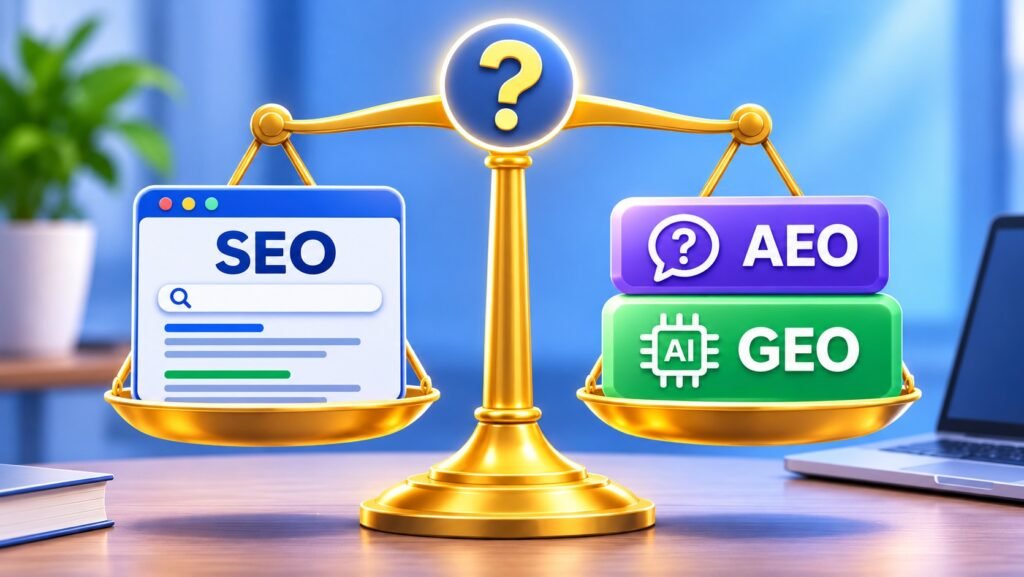
AEO and GEO vs Traditional SEO: What’s the Difference?
You’ve probably heard two terms repeatedly over the last few years:
AEO (Answer Engine Optimization) and GEO (Generative Engine Optimization).
Let’s understand what they mean.
AEO focuses on improving content visibility in answer-based search experiences, where users receive direct answers to their questions.
GEO focuses on improving the visibility of content within generative AI platforms and AI-generated responses.
Both concepts are connected to the way users discover information through AI-powered systems.
But here’s something important.
According to Google’s official guidance, optimizing for Google’s generative AI search features is still part of overall SEO.
This means you don’t need to abandon traditional SEO principles and start following an entirely different strategy just because new terminology has become popular.
Your foundation should remain the same:
- Create helpful and reliable content.
- Maintain proper technical SEO.
- Make your website accessible to search engines.
- Understand and answer users’ questions.
- Provide information that offers genuine value.
- Build a website that people can trust and use easily.
Of course, researching AEO and GEO is not a bad idea.
Different AI platforms may have different ways of discovering, retrieving, and presenting information.
Understanding these systems can help you prepare your content strategy for a wider range of search experiences.
But don’t blindly follow every new SEO technique being promoted as a requirement for Google AI Search.
Before implementing any strategy, check whether it has reliable documentation and whether it actually provides value.
What Should Ecommerce and Local Business Websites Do for AI Search?

AI Search isn’t relevant only to bloggers and informational websites.
Ecommerce websites and local businesses also need to pay attention to how their information appears across Google Search.
Google provides products such as Google Merchant Center and Google Business Profile that help businesses manage information displayed across its search experiences.
Ecommerce SEO: Keep Product Information Accurate
If you run an ecommerce website, make sure your product information is accurate and updated.
Pay attention to:
- Product titles.
- Product descriptions.
- Product prices.
- Product availability.
- Product images.
- Product variations.
- Merchant Center product feeds.
Your product information should match what users actually see on your website.
For example, if your product price changes, make sure the updated information is reflected wherever required.
Similarly, product availability should not show outdated information.
Accurate product data helps Google understand what you’re selling and present relevant product information to users.
Local SEO: Maintain Your Google Business Profile
If you operate a local business, your Google Business Profile deserves attention.
Make sure the following information is accurate:
- Business name.
- Address.
- Contact number.
- Business hours.
- Website URL.
- Business category.
- Products and services.
Keep your profile updated whenever business information changes.
Google Search can display information about local businesses alongside other relevant results, including within relevant AI-powered search experiences.
So, if you’re running a local business, don’t focus only on publishing blog articles. Your business information also needs to be accurate and accessible.
Related Post : How to Fix Discovered – Currently Not Indexed in Google Search Console
How to Measure Your Website’s Performance in AI Search
Now comes an important question.
How will you know whether your website is getting visibility through Google’s AI-powered search experiences?
For years, SEO professionals have relied on Google Search Console to monitor impressions, clicks, average positions, and organic search performance.
With the growth of AI Search, monitoring search visibility requires understanding the additional reporting Google makes available.
Google’s Search Console documentation discusses reporting for generative AI search experiences, including AI Overviews and AI Mode.
Where available, these reporting capabilities can help website owners understand how their content is performing across Google’s search experiences.
You should continue monitoring traditional SEO metrics, but don’t limit your analysis to keyword positions alone.
Look at your website’s broader search performance.
Some important metrics to monitor include:
- Organic clicks.
- Search impressions.
- Click-through rate.
- Average position.
- Landing page performance.
- Search visibility trends.
- Generative AI visibility, where separately reported.
Should You Trust Third-Party AI Ranking Tools?
There are now several SEO tools that claim to track website rankings and visibility across AI platforms.
These tools can be useful for competitive research, monitoring brand mentions, and understanding how your website appears in selected AI responses.
However, there’s one thing you should remember.
Third-party SEO tools don’t have direct access to Google’s internal ranking systems or AI algorithms.
Their reports are based on their own tracking methods, datasets, and estimates.
You can use them to improve your workflow, but don’t treat their AI visibility scores as official Google ranking data.
Always understand what a tool is measuring before making important SEO decisions based on its reports.
Practical SEO Strategy for Google AI Search in 2026
We’ve discussed how Google AI Search works, why traditional SEO still matters, and which practices website owners should focus on.
Now let’s turn all of this into a practical action plan.
If I had to recommend five things to implement on your website, these would be my priorities.
1. Focus on High-Quality, Original Content
Stop creating articles just because you have a list of keywords.
Understand the topic, research the subject, and include your own experience wherever possible.
If you’ve worked on a particular SEO problem, share what you learned.
If you have original data or observations, include them.
Your content should provide something useful that readers cannot easily get from another generic article.
2. Don’t Ignore Technical SEO
Regularly audit your website’s technical health.
Focus on crawling, indexing, website structure, JavaScript SEO, page experience, and duplicate content.
Use Google Search Console to identify indexing issues and monitor important URLs.
Also, check your website regularly to make sure important pages remain accessible.
3. Use AI as a Smart Assistant
AI tools can make content research and preparation faster.
Use them for brainstorming, outlining, research assistance, and improving readability.
But don’t publish AI-generated content without reviewing it.
Add your expertise, verify information, and include original insights.
The final responsibility for content quality remains with you.
4. Avoid Unnecessary AI SEO Hacks
Don’t waste time implementing every new technique promoted as a Google AI Search ranking factor.
You don’t need to create LLMs.txt solely for Google AI visibility.
You don’t need to force every paragraph into tiny content chunks.
And you don’t need a separate article for every possible long-tail keyword variation.
Focus on strategies supported by reliable information and actual user value.
5. Monitor Your Website Through Search Console
Continue tracking traditional organic search performance.
Also, explore the generative AI reporting available in Search Console where applicable.
Understand which pages attract visibility, how your search performance changes, and whether your content is reaching the right audience.
Use third-party tools as additional research resources, not as replacements for official Google reporting.
Related Post : How to Write Human-Written Content: A Complete Guide
Final Thoughts
Google AI Search is changing how people discover information online.
AI Overviews and AI Mode can provide users with direct answers, which may influence how often they click traditional organic search results.
This is something website owners and SEO professionals need to take seriously.
However, it doesn’t mean traditional SEO is finished.
What it does mean is that simply inserting keywords into articles and publishing content regularly is no longer a sufficient strategy.
You need to create content that provides genuine value, maintain strong technical SEO, understand your audience, and share information based on real experience.
Don’t build your website only for search engines.
Build it for people who want to learn something, solve a problem, compare products, or make a purchase.
Because at the end of the day, whether someone discovers your website through traditional Google Search, AI Overviews, or another search experience, the value you provide is what makes your website worth visiting.
I’d like to know your opinion.
Do you think Google AI Overviews will significantly impact organic website traffic? Will SEO professionals need to completely change their strategies, or will traditional SEO continue to remain the foundation of search visibility?
Share your thoughts in the comments.
If you found this article helpful, explore more practical SEO guides, Google updates, and digital marketing insights on SEO Shades.
Frequently Asked Questions (FAQs) on Is SEO Dead After Google AI Overviews
Will Google AI Overviews reduce organic website traffic?
Yes, AI Overviews may reduce clicks for some informational searches by providing direct answers. However, websites can still gain visibility through links included in AI-generated responses.
How can I rank my website in Google AI Overviews?
Focus on helpful, original content, first-hand experience, proper technical SEO, and clear website structure. There is no guaranteed method to appear in AI Overviews.
Does Google prefer AI-generated content or human-written content?
Google doesn’t automatically prefer either. Its focus is on content quality, originality, reliability, and usefulness rather than the method used to create it.
Is GEO more important than traditional SEO in 2026?
No. GEO can complement your SEO strategy, but traditional SEO fundamentals remain important for Google AI Search, including content quality, crawling, indexing, and user experience.
Do I need LLMs.txt to appear in Google AI Overviews?
No. Google does not require an LLMs.txt file for inclusion in AI Overviews or AI Mode. Focus on Google’s established SEO best practices instead.





Comments
No comments yet. Be the first to share your thoughts or ask a question.